
Surge Public Beta Is Live
On April 27, 2026, Surge moved from private to public beta at Bitcoin 2026 Las Vegas - and the feedback that got us there was harder than the launch itself.
 Yash Belavadi4 min read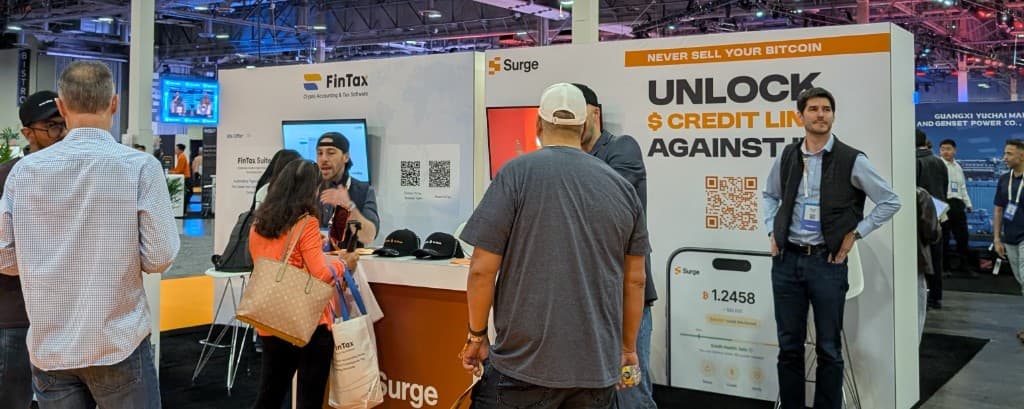
On April 27, 2026, Surge moved from private beta to public beta at Bitcoin 2026 in Las Vegas.
We chose the conference on purpose. If Surge was going to meet the market, it had to happen in front of Bitcoiners - the people who ask the hardest questions about custody, trust, security, and what really happens to their Bitcoin.
Over three days at the booth and during our Workshop 101 presentation, we spoke with Bitcoiners, builders, lenders, investors, and users who want dollar liquidity without selling their Bitcoin. The biggest signal wasn't that people liked the product. It was that they understood why it needed to exist.
From private beta to public beta
Surge opened its private beta waitlist on October 31, 2025. We saw 100+ signups on day one, then tested the product with a smaller group of Bitcoiners from Presidio Bitcoin, early supporters, and close user circles. On December 15, we opened it to a broader group of waitlist users.
That's where the real learning started.
The first feedback wasn't about UI or onboarding. It was about the security model. Who can move the Bitcoin? What happens if Surge disappears? How does the signer network work? Can the borrower recover collateral if coordination fails? Is the Bitcoin actually segregated on-chain, or is it just represented inside an app?
That skepticism was the right response. Bitcoiners have seen enough custodial lenders, wrapped Bitcoin systems, and opaque yield products to know that vague security language isn't enough.
Unilateral exit became the line in the sand
The private beta pushed us to make the failure mode explicit: if Surge stops functioning as expected, the borrower should still have a defined path to recover their Bitcoin after a timelock.
That became the core idea behind unilateral exit.
For us, this is the line in the sand.
🚨 If a Bitcoin credit product depends entirely on a company, custodian, or app staying alive for the borrower to recover collateral, it may be useful - but it is not the kind of non-custodial credit product Bitcoiners are asking for. 🚨
A credit line, not a fixed loan
The second learning was that the credit line model itself mattered.
Most Bitcoin-backed lending products still feel like fixed loans: borrow a fixed amount, for a fixed term, repay under fixed conditions. Surge works differently. Users activate a credit line against their Bitcoin, draw only what they need, repay when they want, and reuse the line again.
That flexibility changed how users engaged with the product. In beta, users started small, drew credit, repaid, and came back. It showed us that Bitcoiners aren't necessarily looking to maximize leverage. Many simply want optionality - access to dollars when needed, without selling Bitcoin or starting a new loan every time.
Rates need to move lower
Rates were the third major learning. Private beta users were clear that Bitcoin-backed credit can't become a serious market if borrowing stays too expensive. The industry average sits above 12%, and smaller positions can price far higher.
Surge responded with a multi-market structure under one borrower interface: variable-rate credit driven by a utilization curve, and fixed-rate credit for users who want predictability. During early public beta, average borrowing APR has been around 6.5%, with fixed-rate credit currently available at 9.9%.
Win-win for both sides of the book: lenders optimize yield, borrowers optimize cost.
What happened at Bitcoin 2026
By the time we launched at Bitcoin 2026, these learnings had shaped the product.
At the booth, people compared Surge directly against other Bitcoin lending products. The feedback we heard repeatedly was that Surge was one of the few products that could clearly explain how the Bitcoin is actually stored and how the system behaves if things go wrong.
Some visitors opened Taproot collateral addresses on block explorers of their own choosing. That moment captured the whole point: Bitcoiners shouldn't have to trust a dashboard when they can verify on-chain.
Where we are now
Since public beta, Surge has reached up to 8 BTC in locked collateral, with Bitcoiners actively borrowing against it. The iOS and Android apps are live globally, our new website is live, and we're continuing to improve the product based on real user behavior.
What's next
Public beta is the next starting point. Over the next 90 days, we're focused on:
- Moving toward a full public launch
- Expanding the Distributed Custody Network with more reputed and aligned signers
- Completing the next phase of audits
- Working with distribution partners who see Surge not just as an app, but as
infrastructure for Bitcoin-backed credit
The bigger vision is simple: Bitcoin-backed credit should feel more like Bitcoin and less like a bank. That means verifiable collateral, zero rehypothecation, transparent markets, unilateral exit, and self-custodial access to dollar credit.
That's what we launched in public beta. And we're just getting started.
Don't trust. Verify. 🟧