
The Liquidation Leaf: The Hardest Part of Bitcoin Lending
Exit and Repayment are easy to feel good about. Liquidation is the leaf that actually determines whether a Bitcoin lending product is safe.
 Yash Belavadi4 min read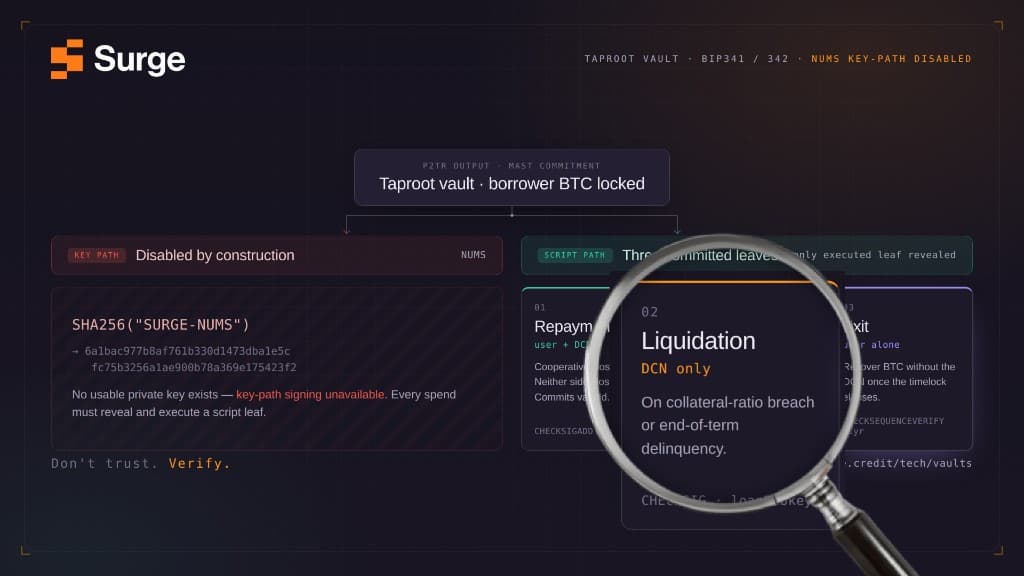
The first two Tapscript leaves are easy to feel good about. Exit gives the borrower a way out that doesn't depend on us. Repayment is the cooperative path.
This one does the most to determine whether a Bitcoin lending product is actually safe: Liquidation.
How the industry liquidates today
Most Bitcoin lending is custodial. The custodian holds your coins, watches whatever price feed they prefer, and moves your collateral when their model says so. The liquidation policy is a clause in a terms-of-service document, not a condition in a script.
DLC-based products improve on this with real cryptography. But a DLC welds its oracle into the contract at creation - there's no path to change oracles without closing the contract. A compromised oracle releases the wrong signature and the contract settles to the wrong outcome with full cryptographic blessing.
Both models, custodial and DLC, resolve liquidation by trusting one source, permanently.
The price feed today, and where it's going
The Liquidation leaf is spendable only with the DCN's signature, and the DCN convenes a signing session only when a collateral-ratio breach is confirmed on-chain. That confirmation depends on a price feed.
Today, both the EVM smart contracts and the DCN read Chainlink, the most battle-tested decentralized oracle in production. Single source for now - but the single source is itself a decentralized network with deep public scrutiny.
The direction is multi-source: read several independent oracles and take an average or median. The Liquidation leaf doesn't bake any oracle into the script; the script is just a CHECKSIG on loanPubkey. What the DCN reads before producing that signature is an operational decision that can evolve. The same Vault that today checks Chainlink can tomorrow check three oracles, without rewriting a byte of script.
🚨 Safety guarantees are committed to the chain. The price source is not. 🚨
50% to draw. 90% to liquidate.
Borrowers can draw up to 50% LTV against their collateral. The 90% LTV threshold is where liquidation conditions become satisfiable.
Between 50% and 90% is the range a position lives in if price moves against the borrower - and within that range, the Vault carries health labels that progressively encourage the borrower to add collateral or repay before the position approaches the threshold.
50% to draw. 90% to liquidate. The space between is a runway.
The DCN can sign, but only because it can't sign for nothing
The script looks dangerous in isolation: a single CHECKSIG on the DCN's loanPubkey, no second party. If you read only the script, the DCN can drain your Vault whenever it wants.
That misses what the DCN is. It's an m-of-n threshold Schnorr signing network. No individual signer holds the private key for loanPubkey; a signature only exists when a quorum of independent signers participates. And the quorum only convenes when the chain confirms the position has breached.
Sole spendable in the script. Not solely spendable in practice.
The Dutch auction: permissionless, cross-chain
When a Vault is liquidated, the collateral has to be converted to settle the debt. Most lenders run this as a black box - the custodian sells through whatever desk they prefer, at whatever spread that desk gives them, with no obligation to disclose the route.
The protocol runs a Dutch auction instead. The auction opens on Base, where price discovery happens fast and cheap. Any participant can bid, the price descends on a published curve, and the first valid bid takes the position. The collateral itself moves on Bitcoin, with the DCN signing the on-chain transfer.
That cross-chain split is deliberate. The auction lives where speed and openness are cheap. The asset delivery lives on Bitcoin, where the collateral has been all along.
There's no privileged liquidator, no off-exchange handshake, no spread captured by an insider. Liquidations today are full liquidations: the position closes, the debt is settled, any BTC remainder is returned to the borrower, and the credit line terminates.
Why it scales credit
Most Bitcoin lending centralizes liquidation trust into a custodian, or permanently into one oracle, and settles collateral through a private channel that captures spread.
The Liquidation leaf takes a different trade:
- Trigger: a price feed that today is Chainlink and tomorrow is multiple
oracles aggregated
- Signature: an m-of-n threshold across independent DCN signers
- Threshold: 90% LTV
- Settlement: a permissionless Dutch auction on Base, delivered as BTC on
Bitcoin
Same script for every Vault, isolated by vaultId. The blast radius of any single liquidation is exactly the collateral inside the breaching Vault, sold in an open auction, with any remainder returned to the borrower.
The credit book grows. The blast radius does not. The thing you have to trust does not.
Don't trust. Verify. 🟧